Membrane filtration
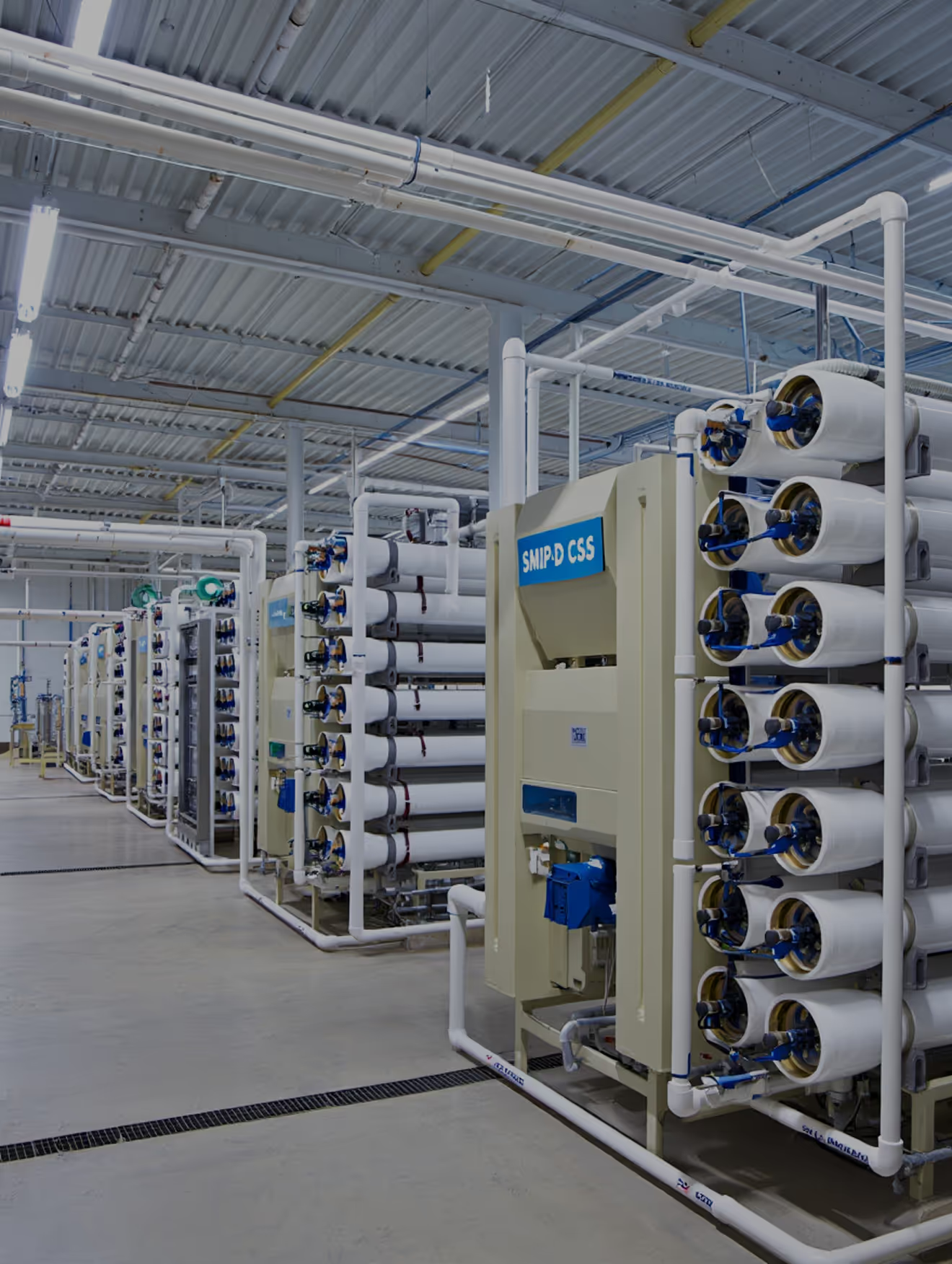
The growing demand in water and wastewater treatment is to produce increasingly higher-quality treated water from ever more polluted raw water and wastewater, within a smaller footprint, with greater reliability, and in a more environmentally friendly manner. Membrane technologies—especially MBR and UF systems—offer alternative solutions to meet these requirements.
The membrane as an “invisible filter”
A membrane can be imagined as an extremely fine filter wall through which only particles of a certain size can pass. Anything larger than its pores is retained: suspended solids, bacteria, and microorganisms. Membranes therefore purify water not through biological or chemical processes, but by physical separation.

UF – Ultrafiltration
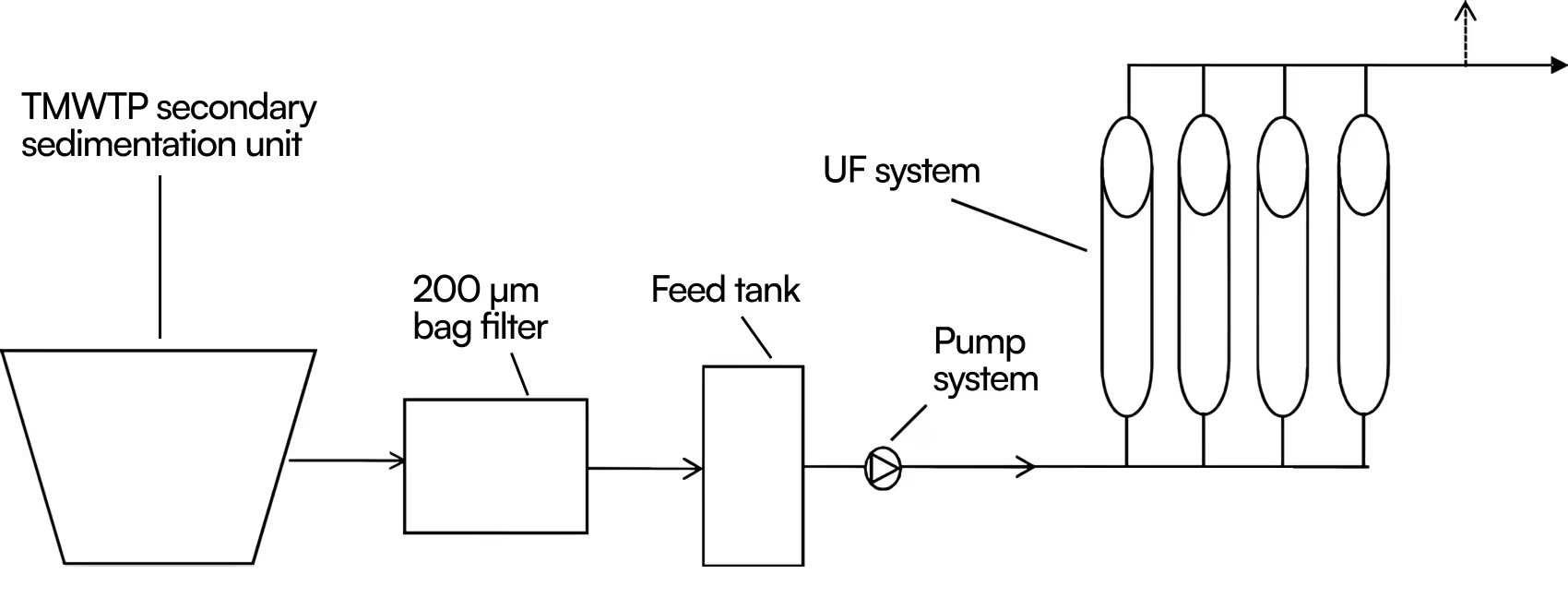
UF (ultrafiltration) membranes have pores in the microscopic range, on the order of hundredths of a micrometer. This pore size allows them to:
- remove suspended solids,
- filter out bacteria,
- retain colloidal particles,
- and partially remove viruses.
UF membranes do not alter the chemical composition of the water; dissolved salts and small molecules pass through them. For this reason, UF is often used as a pre-treatment or post-treatment step, for example in drinking water preparation or in industrial processes.
MBR – Where biology meets the membrane
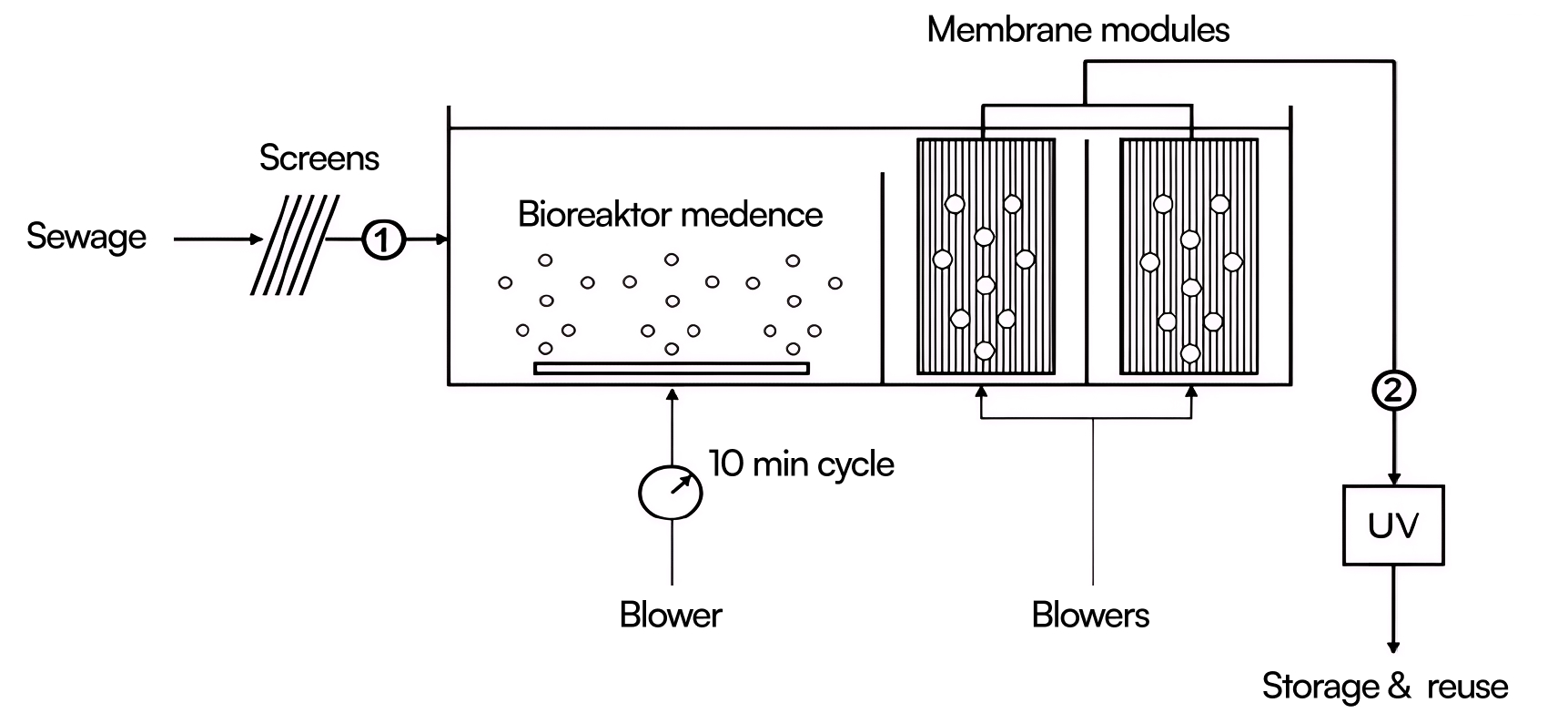
MBR (Membrane Bioreactor) technology goes one step further. Here, the membrane is not a separate unit but an integral part of the wastewater treatment process.
In conventional wastewater treatment plants, sludge is separated from water after biological treatment by a secondary clarifier. In MBR systems, this phase separation function can be replaced by the membrane. The membrane retains all activated sludge and microorganisms, which means that:
- the treated water phase is cleaner,
- bacteria cannot “escape” from the system,
- the treatment plant can be implemented on a much smaller footprint.
MBR systems most commonly use UF membranes, either submerged directly in the biological tank or installed in a separate module. MBR technology makes it possible to produce treated water of a quality that:
- is suitable for industrial reuse,
- reduces the load on receiving waters,
- contributes to circular water management.
UF and MBR are not competing technologies but solutions designed for different tasks. The choice depends on what substances must be removed, the required effluent water quality, and where the technology fits within the overall system.
When is UF (Ultrafiltration) ideal, and when is MBR (Membrane Bioreactor)?
UF is a good choice when the goal is physical purification and reliable filtration, rather than biological degradation of organic matter.
UF is recommended if:
- the pollution is mainly suspended solids, colloids, or microbiological in nature,
- the water has already been pretreated (e.g. after clarification or biological treatment),
- a constant and predictable water quality is required,
- reliable filtration is needed for process water or as RO pretreatment,
- an existing system must be upgraded with minimal intervention.
Typical applications:
- drinking water treatment,
- industrial process water,
- wastewater polishing,
- preparation for water reuse.
When is MBR (Membrane Bioreactor) advantageous?
MBR is recommended if:
- complex treatment of municipal or industrial wastewater is required,
- stricter discharge limits must be met for COD, BOD, and suspended solids,
- available space is limited,
- stable operation is required even under fluctuating loads,
- reuse of treated water is an objective.
Typical applications:
- municipal wastewater treatment plants,
- food and chemical industry wastewaters,
- expansions or reconstructions replacing secondary clarifiers,
- protection of sensitive receiving waters.
Technology selection based on cost–performance
Membrane-based technologies provide very high treatment quality, but both capital and operating costs are higher than those of purely biological systems.
In broad terms, compared to a conventional system, the cost of an MBR is approximately 1.5–2.5 times higher, and even compared to a standalone UF unit, the cost difference can be 2–3 times.
UF is the more economical choice if:
- an existing system is being refined,
- the required water quality is not extreme,
- low capital investment is the primary consideration.
MBR is a more expensive but more comprehensive solution if:
- strict discharge limits must be met in a new or fully rehabilitated wastewater treatment plant,
- space constraints or water reuse requirements are decisive factors.