Types of wastewater treatment plants (continuous-flow and SBR systems)
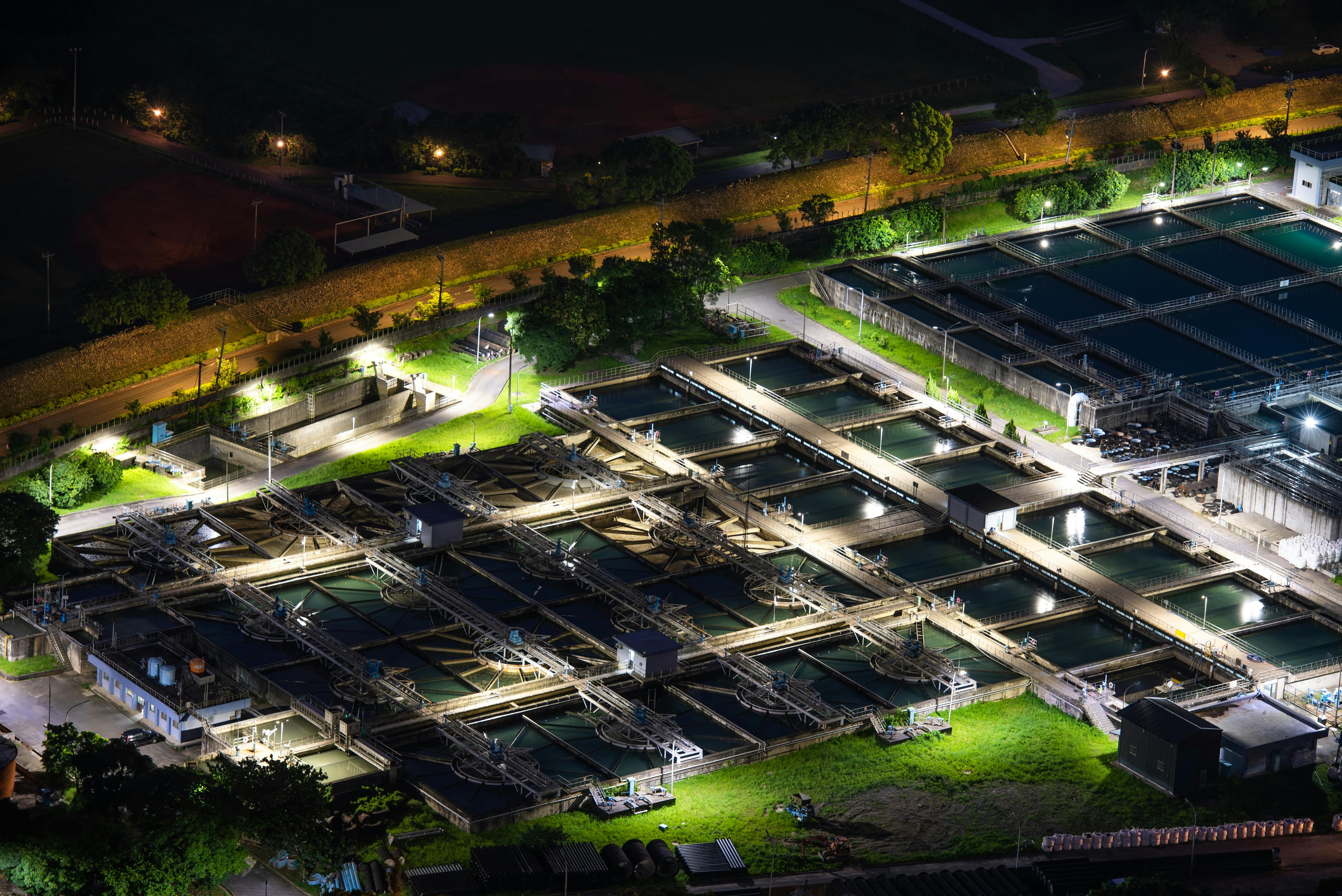
The land requirement, investment cost, operating expenses, and operational flexibility of a wastewater treatment plant are fundamentally determined by the applied technology. The following overview presents the main operational and economic differences between conventional continuous-flow systems and the more advanced SBR technology in several respects.
Conventional technology
In conventional, so-called continuous-flow wastewater treatment plants, wastewater passes sequentially through the treatment stages. The system consists of separate units: preliminary treatment, primary sedimentation, biological treatment (activated sludge basin), followed by secondary clarification. Influent and effluent flows are continuous, and the processes are spatially separated.
SBR technology
In contrast, the SBR (Sequencing Batch Reactor), also known as a batch-operated reactor, combines the functions of biological treatment and sedimentation within a single tank, separated in time rather than space. Wastewater inflow, aeration, settling, and discharge of treated water occur cyclically according to a predefined operating schedule. There is no separate secondary clarifier, resulting in fewer structures, a more compact layout, and a simpler hydraulic system.
Advantages and disadvantages
Continuous-flow systems operate reliably under stable hydraulic loading; however, they are more sensitive to load fluctuations and more prone to losing activated sludge, which reduces the required sludge age. Nitrification and denitrification are often tied to separate zones. Due to the need for separate reactor and clarifier tanks, the land requirement of these plants is significantly higher than that of SBR-based facilities.
SBR systems provide a high degree of operational flexibility. Aerobic, anaerobic, and anoxic phases can be precisely controlled in time, enabling more efficient nitrification–denitrification. They adapt more easily to fluctuating wastewater volumes and pollutant loads. A key advantage is that, compared to conventional systems, SBR plants can be implemented in much smaller and more cost-effective structures, with reduced mechanical equipment, resulting in more economical operation. Their main disadvantage is that, despite offering superior performance in many parameters compared to conventional continuous-flow plants, the technology is relatively young and therefore has fewer established references.
